
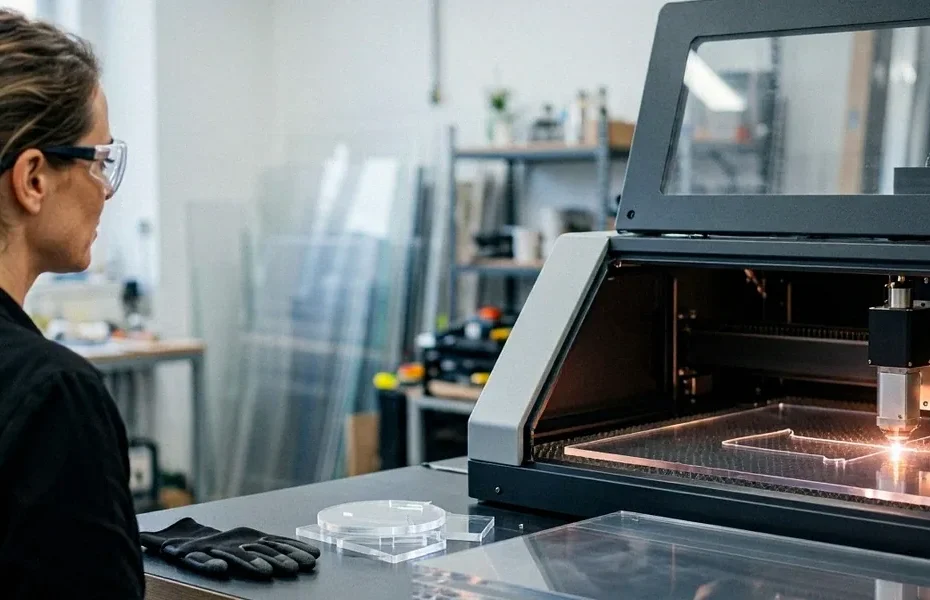
Laser Cutting Acrylic: Settings and Safety
The first time we tried laser cutting acrylic, we ruined three sheets of Perspex in under an hour. We had the power cranked too high, no air assist, and a workshop that smelled like a burning chemistry lab. The edges came out bubbly, one sheet cracked along the cut line, and we spent the rest of the afternoon scrubbing residue off the bed. That expensive afternoon taught us more than any manual could, and this guide is our attempt to save you from the same mistakes.
Why Laser Cutting Acrylic Is a Game-Changer for UK Makers
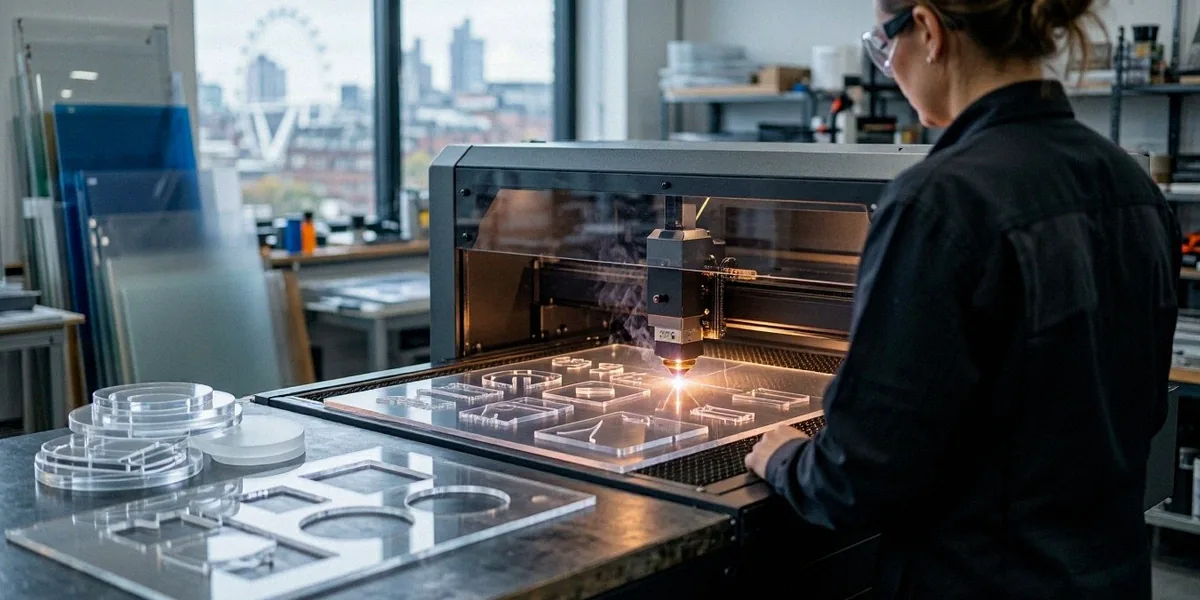
Acrylic sheet has been a staple of UK sign-making and display fabrication for decades, and Perspex is the brand most people reach for first. Laser cutting turns this material from something you saw and drill into something you can shape with sub-millimetre accuracy. For small workshops in Birmingham, Manchester, or Glasgow, a desktop laser cutter has effectively replaced a whole bench of manual tools.
Precision and Speed for Complex Designs
A CO2 laser will cut intricate logos, interlocking parts, and fine lettering straight from a vector file. There is no tool wear, no clamping drama, and no need to drill pilot holes. A design that would take an hour with a scroll saw is finished in minutes, and every repeat job comes out identical.
Cost-Effectiveness for Small Businesses
Offcuts get used instead of binned, nesting software squeezes more parts onto each sheet, and one operator can run the machine while doing other work. For a business producing acrylic displays, point-of-sale stands, or bespoke components, that combination of low waste and low labour cost is what makes the numbers work.
Understanding Acrylic Sheet and Perspex for Laser Cutting
Not all acrylic behaves the same under a laser. Perspex is a widely used brand of acrylic sheet in the UK, and it comes in both cast and extruded forms. Knowing which one you have in your hand determines half of your settings before you even switch the machine on.
Cast vs. Extruded Acrylic: Which One to Choose?
Cast acrylic is made by pouring monomer between glass plates. It laser cuts cleanly, engraves to a frosty white, and resists stress cracking. Extruded acrylic is pushed through a die, which makes it cheaper and more uniform in thickness, but it tends to melt and produce a gummier edge under the beam.
- Cast acrylic: best for engraving, flame-polished edges, and structural parts.
- Extruded acrylic: fine for straight cuts and simple shapes where cost matters most.
- Perspex cast sheet: the safe default if you are unsure which you have.
Common Thicknesses and Their Applications
Most UK suppliers, including Perspex Distribution, stock sheet from 1mm up to 25mm. The 2mm to 3mm range covers signage and display stands. The 5mm to 10mm range suits brackets, housings, and retail fittings. Anything above 15mm usually needs multiple passes or a higher-wattage tube, and 25mm is really the practical ceiling for most workshop lasers.
Essential Laser Settings for Acrylic: Power, Speed, and Frequency
Every machine is different, so treat the numbers below as starting points rather than gospel. Trotec and Epilog are popular laser cutter brands among UK makers, and both publish material databases worth checking against your own tube. Always run a test cut on scrap before committing a full sheet.
Power Settings: Finding the Sweet Spot
For 3mm cast acrylic on a 60W CO2 laser, we usually start around 60–70% power at 15mm/s. Too much power scorches the edges and leaves a yellow halo. Too little leaves a rough, frosted cut that needs snapping. Increase power in small increments rather than jumping straight to 100%.
Speed and Frequency: Balancing Cut Quality and Efficiency
Slower speeds give a more polished edge but risk heat build-up and melting. Faster speeds reduce charring but may not cut through. Frequency, usually set between 5,000 and 20,000Hz on a CO2 tube, controls how tightly the pulses are spaced. Lower frequencies produce a coarser cut; higher frequencies give a smoother finish on thinner material.
Focus and Air Assist: Critical Adjustments
Focus the beam on the middle of the material for the cleanest cut. Air assist should be running at a steady, moderate pressure to blow vapour away from the kerf. Without it, fumes re-deposit on the surface and you get that sticky, cloudy film we mentioned earlier.
Safety First: Protecting Yourself and Your Workshop
Acrylic fumes are not something to shrug off. UK regulations such as COSHH apply to laser cutting fumes, which means you have a legal duty to assess and control exposure. Methyl methacrylate vapour is irritating to the eyes and respiratory tract, and the fine particulates from engraving are worse.
Ventilation and Fume Extraction
You need extraction that vents outside, ideally through a filtered unit if you are in a shared building or residential area. A carbon filter plus HEPA stage will handle most acrylic work. Recirculating a cheap desk unit in a closed room is not adequate.
Fire Prevention and Emergency Procedures
Never leave a running laser unattended. Keep a CO2 extinguisher within reach, not a water or foam one. Clean the bed regularly because acrylic residue is flammable, and keep a damp cloth nearby for smothering small flare-ups.
Personal Protective Equipment (PPE)
- Safety glasses rated for the laser wavelength you are using.
- Nitrile gloves when handling freshly cut edges and solvent cements.
- An FFP2 or FFP3 mask if you are cleaning the bed or emptying the extraction filter.
Troubleshooting Common Issues in Laser Cutting Acrylic
Most acrylic problems come down to three things: wrong material, wrong settings, or dirty optics. Work through them in that order before you start blaming the machine.
Melting and Residue: Causes and Fixes
Melting usually means too much power, too slow a speed, or extruded sheet instead of cast. Switch to cast acrylic from a UK supplier like Perspex Distribution, drop the power by 10%, and check your air assist is actually flowing. Residue on the surface often points to a dirty lens or a clogged nozzle.
Cracking and Stress Fractures: Prevention Tips
Acrylic cracks when internal stress meets a sharp corner or a solvent. Design with radiused corners, avoid forcing tight bends, and anneal parts that will be drilled or bonded. If a sheet cracks along the cut, your settings were likely too hot and the material cooled too fast.
Achieving Flame-Polished Edges
A clean, well-tuned cut on cast acrylic gives you a near-polished edge straight off the bed. If you need more shine, a quick pass with a flame polisher or a careful hit with a butane torch will do it. Practise on offcuts first, because it is easy to bubble the edge in a second.
Post-Processing and Finishing Techniques for Acrylic
Cutting is only half the job. The finishing steps are what separate a functional part from a professional-looking one.
Annealing to Relieve Internal Stress
Annealing involves heating the part in an oven to around 80°C, holding it for a period based on thickness, then cooling it slowly. This relieves the internal stress that laser cutting introduces and dramatically reduces the risk of crazing later.
Flame Polishing for a Glass-Like Finish
A hydrogen-oxygen flame or a fine butane torch passed quickly along the edge will melt the surface into a clear, glassy finish. Keep the flame moving, work in one direction, and stop before the edge starts to round over.
Bonding Acrylic with Solvent Cements
Tensol is a commonly used solvent cement for bonding acrylic in the UK, and it is available from most sign-making suppliers. Apply with a syringe along a clean joint, let capillary action pull it through, and clamp lightly. Work in a ventilated area because the vapours are strong.
FAQ
Can I laser cut Perspex on any CO2 laser?
Yes, provided the machine is powerful enough for the thickness. A 40W cutter handles 3mm comfortably; 6mm and above really wants 60W or more. Diode lasers struggle with clear acrylic because the wavelength passes straight through.
Is laser cutting acrylic safe indoors?
Only with proper fume extraction vented to the outside. COSHH requires you to assess exposure, and recirculating unfiltered fumes into a workshop is not acceptable under UK guidance.
Why does my acrylic keep melting instead of cutting?
Nine times out of ten it is extruded sheet, too much power, or too slow a speed. Switch to cast acrylic, reduce power, and check your air assist before adjusting anything else.
Where can I buy cast acrylic sheet in the UK?
Perspex Distribution is a major UK supplier and stocks cast Perspex in a wide range of thicknesses and colours. Most local sign-making suppliers also carry cut-to-size offcuts that are ideal for testing.
Do I need to anneal every acrylic part?
No, but you should anneal anything that will be drilled, bonded, or exposed to stress. Flat display panels rarely need it; load-bearing brackets almost always do.
Mastering laser settings and safety protocols is what turns acrylic sheet from a frustrating material into one of the most versatile things in a UK workshop. Get the material right, dial in your power and speed, respect the extraction rules, and you will produce acrylic displays and components that look like they came out of a factory, not a garage.